
Guillotine vs Swing Beam Shear
Published · Updated
Compare equivalent model rows, useful adjustments and accepted cuts. The design name alone does not establish burr, flatness or dimensional accuracy.
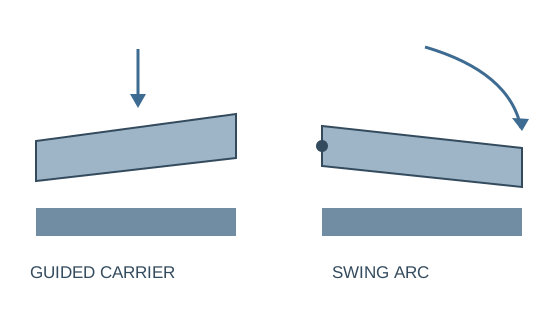
Two designs, one finished-cut requirement
Guillotine carrier
The upper blade is guided through the cutting motion. The published range lists adjustable rake angles; confirm how rake and clearance are set on the quoted model.
Adjustment is useful only if it supports the material changes and strip sizes in your production.
Swing-beam carrier
The upper blade travels through an arc. Compare the actual material rating, hold-downs, supports and gauge functions rather than assuming the arc defines a particular finished tolerance.
Trial the narrow retained strip and full cutting length that your orders require.
Compare the same size: 6×3200
| Item | Guillotine | Swing beam |
|---|---|---|
| Thickness / width | 6 mm / 3200 mm | 6 mm / 3200 mm |
| Angle | 0.5–1.5° rake range | 1.3° cutting angle |
| Strokes per minute | 10–25 | 14 |
| Backgauge | 750 mm listed distance | 20–600 mm range |
| Motor | 7.5 kW | 7.5 kW |
Scroll the comparison table horizontally to see every column.
The table below compares 6×3200 rows from the guillotine and swing-beam references. Confirm the material-strength basis of their thickness ratings. Published strokes describe machine cycling, not useful parts per hour.
Backgauge travel describes positioning distance, not guaranteed finished accuracy. Check support for long blanks and the smallest strip dimension you need to produce.
The dimensions belong in different columns
Cutting length / thickness
Confirm capacity for the actual grade at the full cut. Do not apply a material-unspecified 6 mm maximum to every metal.
Backgauge travel
The travel figure describes positioning distance. It is not a guarantee of completed-strip accuracy or usable support at every size.
Strokes per minute
The cycle frequency excludes loading, positioning, removal and inspection. Time the complete batch to compare useful output.
A change of material is a change of setup
The guillotine reference lists adjustable rake ranges. Ask how rake and blade clearance are set on the selected model and which functions are controlled or manual. Record the frequency of material and thickness changes.
For repeated strips, evaluate backgauge use, support and part removal. For mixed plate work, trial the narrowest strip and most demanding grade. More adjustment capability is valuable only if it helps operators process the actual jobs.
Test four cut outcomes
Full-width blank
Check the finished length and squareness under the agreed measurement method. Include the real sheet support and positioning route.
Narrow retained strip
Check twist and bow on the component you keep. A neat offcut alone does not establish the strip your downstream process uses.
Edge and finish
Inspect burr, marks and any required finishing. Define acceptable results for the grade and application.
Also inspect material handling and the removal route. Compare the blade supply, control functions and supports included in each proposal with the same finished-cut criteria.
Straight cuts or profile cutting?
A straight-blade shear is useful for straight blanks and strips. Curves, nested profiles and internal contours require a different cutting process; review plasma versus laser before assigning those parts to a shear.
Guillotine hydraulic range
Use the selected row, material confirmation and actual adjustment/control scope.
View configuration →Swing-beam hydraulic range
Use the selected row, material confirmation and actual support/gauge scope.
View configuration →Compare complete cuts from the same cut list
WinYing Machinery can review the material and cut dimensions before discussing a hydraulic shear. Include your narrowest strip and agreed edge criteria in the quotation and trial.
Discuss this application →- 01Grade and thickness range
- 02Maximum cutting length and narrowest strip
- 03Gauge / support requirements
- 04Batch mix and accepted cut measurements
Frequently Asked Questions
Is guillotine always more accurate?
No universal finished-cut accuracy is established by the design. Evaluate samples and positioning.
Is 6 mm valid for every metal?
Obtain confirmation for the actual grade and full cutting length.
Are strokes finished output?
No. Loading, positioning and removal affect batch output.
Does backgauge travel equal accuracy?
No. Measure positioning and completed dimensions independently.