
Build the Right Sheet Metal Shear Specification
Published · Updated
Start with the blanks you need to deliver. Grade, full cutting length, narrow strips and handling decide the useful machine—not one headline maximum.
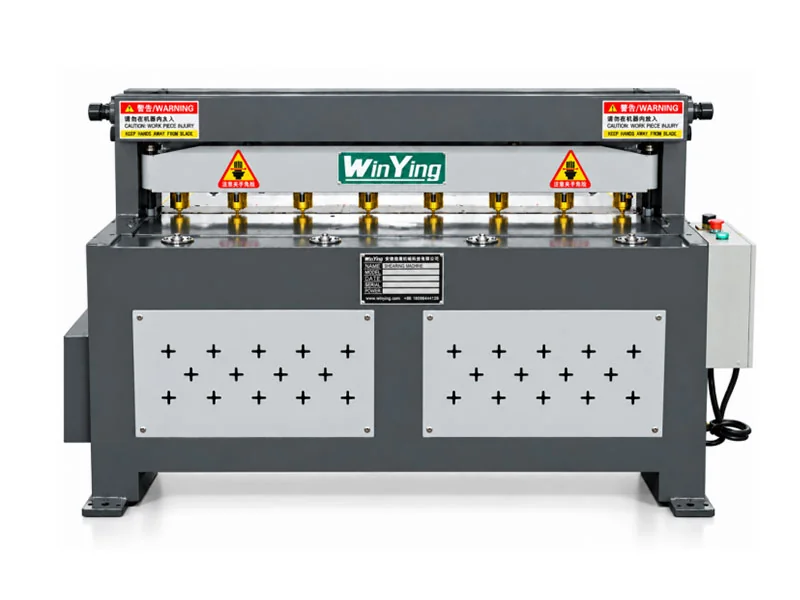
Turn the cut list into a purchasing worksheet
Requirement
What you provide
What the quotation confirms
Material
Grade, thickness range and surface
Capacity at full working length
Finished blank
Longest cut and narrowest retained strip
Gauge travel, support and removal
Quality
Dimensions, burr, twist and finish
Agreed measurement and sample limits
Production
Batch mix, changes and operators
Accepted output including handling
Choose the class of machine around the job
Manual workshop work
For appropriate lighter work and short batches, confirm operator effort, stock support and repeat positioning. Do not assume a universal thickness boundary from the manual label.
Powered sheet cutting
For recurring straight blanks, check the electric model, gauge operation and handling cycle. Ask what supports and controls are included, not just whether it has a motor.
Hydraulic plate cutting
For the proposed plate work, compare the selected material/length rating and useful adjustments. Obtain grade-specific confirmation before using a catalog maximum.
Two published rows show why model selection matters
Swing beam 4×2500
4 mm × 2500 mm
The row lists 20–600 mm backgauge range. Confirm grade, full cutting capacity and support for your narrow strips.
Guillotine 6×3200
6 mm × 3200 mm
The row lists 750 mm backgauge distance. It is a different thickness/length example, not proof that the two designs have the same usable output.
The material-strength basis must be confirmed for either row. A maximum thickness is not a general rating for stainless, aluminum and every other grade.
Follow the sheet, not just the cutting stroke
- 01Load
Use the actual sheet size and loading method.
- 02Support
Keep the long or thin blank positioned as intended.
- 03Gauge
Set and verify the required retained dimension.
- 04Cut
Use the selected machine procedure and setup.
- 05Remove
Handle parts and offcuts, then inspect the batch.
Confirm how the backgauge is set, available supports, hold-down operation and removal of cut parts. Ask whether the quoted machine includes front supports, sheet handling aids and the control functions required for repeated cuts. Travel range is not finished dimensional accuracy.
Long thin panels can need careful support; heavy plates require a suitable loading method. Include service access and offcut collection in the layout. For non-rectangular contours and holes, consider profile cutting instead.
Make the acceptance trial useful downstream
Blank dimensions and repeat positioning
Cut repeated dimensions, the longest blank and the smallest strip. Agree length and squareness measurements and compare samples from the batch.
Edge and form after cutting
Inspect burr, twist, bow and surface condition. Where the blank is folded, welded or assembled later, test that downstream operation with the trial blank.
- Supply representative grades and thicknesses.
- Cut full-length blanks, narrow strips and repeated dimensions.
- Check length, squareness, burr, twist and surface condition.
- Demonstrate thickness changes and gauge adjustment.
- Measure usable batch output including loading and removal.
Agree tolerances and inspection methods in the order. Published strokes or maximum speed do not establish accepted parts per hour.
Straight blades have a defined process boundary
A shear makes straight cuts. If the production drawing includes curves, internal contours or nested profiles, review profile cutting. Buying more shear capacity does not add those toolpaths.
| Requirement | Provide | Confirm |
|---|---|---|
| Material | Grade and thickness range | Capacity at full cut length |
| Cut list | Longest cut and narrowest strip | Gauge travel and supports |
| Quality | Dimensions, burr and flatness limits | Sample inspection method |
| Production | Batch mix and shifts | Complete handling cycle |
| Installation | Layout and power standard | Loading/access and supply scope |
Scroll the comparison table horizontally to see every column.
Send the cut matrix, not only the largest thickness
WinYing Machinery reviews stock, blank dimensions and production needs before discussing a shear configuration. The cut list makes two quotations comparable and identifies missing supports or controls.
Discuss this application →- 01Grade and minimum / maximum thickness
- 02Sheet size, longest cut and retained strips
- 03Finished dimensions and edge criteria
- 04Batch changes, layout and power standard
Frequently Asked Questions
Can I choose using maximum thickness only?
No. Grade, full cutting length, support and cut quality must also be confirmed.
Will a shear cut curved profiles?
A straight-blade shear makes straight cuts. Curves and internal contours need a suitable alternative process.
Do I need CNC for repeated strips?
Define the positioning and program requirements first, then confirm the quoted controller functions.
What proves the required edge quality?
Sample cuts with your material, agreed measurements and written acceptance limits.