
Plasma vs Fiber Laser Cutting
Published · Updated
Compare the profiles and edge conditions your next process needs. Machine limits, cutting speed and positioning accuracy describe different things; an accepted part trial connects them to the purchase.
Two configurations to compare, not two universal promises
120A
CNC plasma reference
1500×3000 mm work area; Huayuan 120A source; STARfire/Starcam; automatic torch height. The page lists a maximum 25 mm carbon-steel reference.
Fiber laser reference
3048×1524 mm work area; 1.5/2/3 kW options; MAX source, Raytools components and air/oxygen/nitrogen options.
Confirm material and thickness for the exact source/power/gas combination. A maximum listed thickness should not be read as a maximum-speed production condition.
What happens after the cut determines useful quality
Parts for later welding
Trial the edge and fit required by the specified fabrication route. Include any cleaning or preparation work in the accepted-part cost.
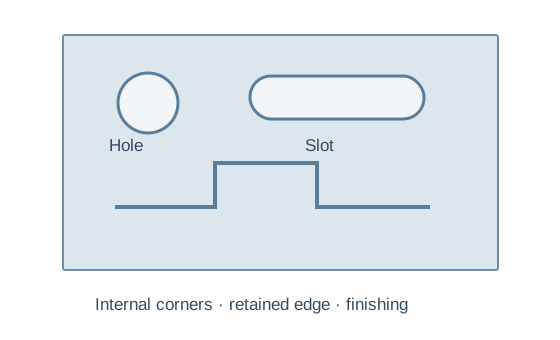
Parts with small internal features
Include the smallest required holes, slots and difficult corners. Check their completed dimensions and edge condition, not only a straight external contour.
Parts with visible edges
Specify the cosmetic finish and permissible finishing effort. Count dross/burr removal and surface work rather than treating it as free downstream labor.
Specify grades, thickness mix, sheet sizes, smallest holes, internal profiles and finished tolerances. State whether parts are welded, painted, bent or used with visible cut edges. The required downstream work influences how much finishing is acceptable.
Plasma uses an electrically generated arc for conductive metals; fiber laser uses focused laser energy with an appropriate cutting configuration. Both follow programmed profiles, unlike a straight-blade shear. Actual quality depends on material and setup, so compare trials rather than assuming a universal process ranking.
Compare measurement categories honestly
| Item | 1530 plasma | NS3015L fiber laser |
|---|---|---|
| Work area | 1500×3000 mm | 3048×1524 mm |
| Source | Huayuan 120A | MAX; 1.5/2/3 kW options |
| Control | STARfire/Starcam | Raytools reference |
| Height/cooling | Automatic torch height | S&A water cooler |
| Capacity check | 25 mm carbon-steel maximum reference | Power/material-specific confirmation |
| Acceptance | Finished edge/holes and finishing | Finished edge/holes and finishing |
Scroll the comparison table horizontally to see every column.
A trial should follow the part all the way to acceptance
- 01Use stock
Use the proposed grades and thickness mix.
- 02Cut features
Include the small holes and internal contours.
- 03Inspect edge
Measure dimensions and the agreed edge criteria.
- 04Finish part
Record required cleanup and next-process fit.
- 05Count output
Compare accepted pieces over the batch.
Use the same inspection criteria, representative drawing pack and material for the comparison. Maximum speed, source amperage and laser power are not interchangeable measures of completed output.
Build a cost comparison without invented ROI
Machine-operation inputs
Confirm source, head/torch, drive and control scope. Include actual gas/air quality, electrical demand, cooling/extraction and the replacement/consumable information for the selected configuration.
Complete-part inputs
Add nesting/program setup, loading, cutting, cleanup, inspection and material handling. The cheaper machine cycle can be offset by required finishing or rejected profiles.
Ask for supplier cutting data and your own measured trial. No generic cost-per-part number on this page can replace the actual stock, profiles, utilities and quality requirements.
Send a representative drawing pack
WinYing Machinery reviews materials and profile requirements before discussing a cutting configuration. Identify the difficult features and required downstream finish, then compare proposals on accepted parts.
Discuss this application →- 01Material and thickness mix
- 02Sheet sizes and smallest features
- 03Final tolerances and finishing limits
- 04Utilities, batches and next fabrication process
Frequently Asked Questions
Can maximum thickness be cut at maximum speed?
Do not assume so. Obtain material- and thickness-specific cutting data and a demonstration.
Does positioning accuracy equal cut-part accuracy?
No. Process, material, setup and measurement also affect the finished part.
Which process is cheaper?
Compare accepted parts, finishing, utilities, consumables and handling for your job mix.
Are every laser power and gas option included?
Confirm the exact source, power, head and gas configuration in the supply scope.