
Pipe Bender or Tube Bender? Specify the Workpiece
Published · Updated
Commercial names overlap. Translate the stock label into measured dimensions, grade and a finished drawing before choosing a bending method or tooling.
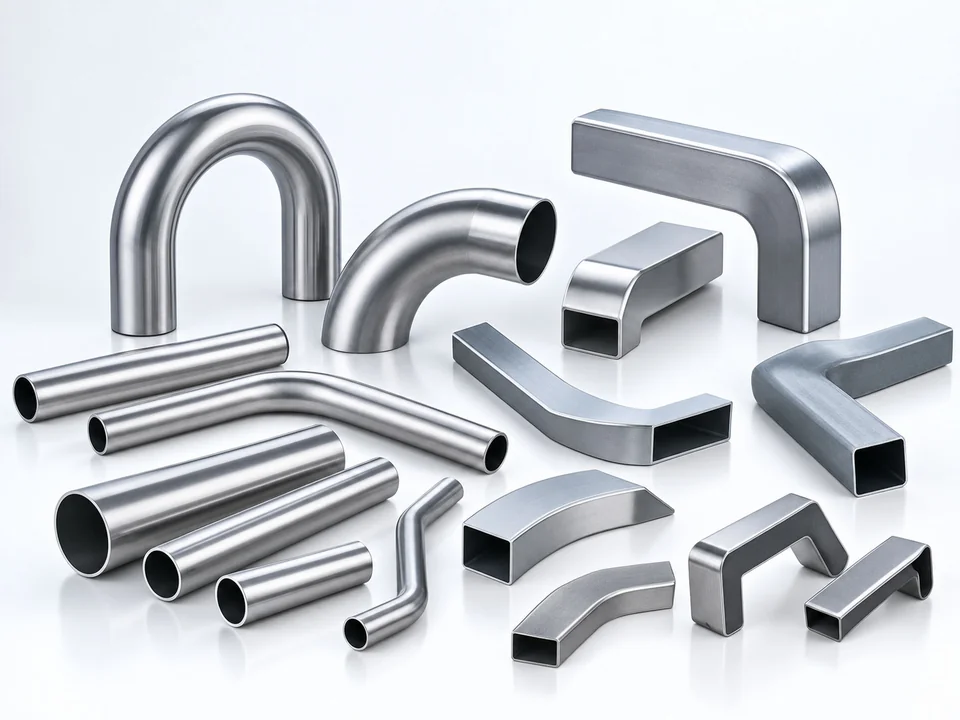
Two stock labels should become one clear specification
Nominal size + schedule
Provide the actual outside diameter and wall data from the material specification. The nominal name is not the measured diameter the tool must fit.
Outside dimensions + wall
Provide OD for a round tube, or full section dimensions and corner details for a non-round tube. Include grade, temper and surface requirement.
Pipe may be described by nominal size and schedule, while tube is commonly ordered by outside diameter and wall. Send the actual dimensional data from the material specification; do not treat a nominal size as measured outside diameter.
State grade, shape and finish as well. Round and rectangular sections need different tooling. A maximum diameter without wall thickness is incomplete, and a stated diameter×wall capacity still needs confirmation for the material and radius.
The bending tool fits geometry, not a marketing label
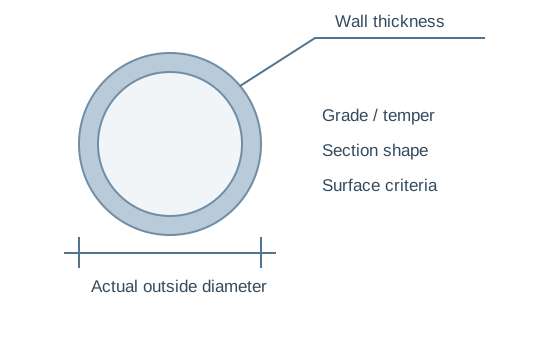
State the complete stock data
A maximum diameter without wall thickness is incomplete. A diameter×wall rating still needs confirmation for the material, radius and full sequence.
For rectangular/square sections, also review matching tool profiles, corner condition and the permitted deformation. Do not assume a round-tube die supports them.
A label such as pipe, tube or profile should lead to these questions rather than decide the quotation.
Choose one of three genuinely different production routes
Localized tube bends
Individual bends with straight lengths can suit frames, routing components and other tube parts. Review bend radius, angles, clamp access and the whole sequence.
Continuous large-radius arches
Roll bending progressively forms broad curves. A greenhouse arch needs tube data, span, rise or radius and the required final arc.
Sheet-metal duct elbows
Segmented HVAC elbows are assembled from sheet-metal pieces and joints. They are not a solid-wall tube being bent on a pipe bender.
Read a capacity as a paired size, not a diameter headline
The hydraulic DW38NC row lists Φ38×2 maximum capability, while the CNC DW-38CNC row also lists Φ38×2. That similarity does not establish equal tooling, radius range, axes or output. Each selected machine needs a material and full-geometry review.
The WY-51 page lists diameter up to 51 mm and a 3 mm thickness scope. Obtain confirmation of the diameter/wall/material combination and required radius rather than combining headline limits into a universal capability.
From stock description to a finished-part drawing
| Stock label | Actual information needed | Machine question |
|---|---|---|
| Nominal pipe | Measured OD, wall/schedule data, grade | Which dies and confirmed capacity? |
| Round tube | OD, wall, grade | Required radius and support? |
| Non-round tube | Full section, wall, corner details | Matching tooling and deformation? |
| Greenhouse pipe arch | Tube data, span/rise/radius | Roll-bending configuration? |
| Sheet-metal duct elbow | Sheet, segments and seam drawing | Elbow-forming equipment? |
Scroll the comparison table horizontally to see every column.
- State actual outside dimensions and wall thickness.
- Specify material grade and stock length.
- Dimension centerline radii and bend angles.
- Show straight lengths, rotations and end details.
- State finished quality and batch quantities.
Review radius and wall effects before the tooling discussion. Include ovality or appearance requirements where they matter to part function.
Two workshop inquiries that need different answers
A repeat handrail or frame part
Send the complete local bend sequence, rotations, straights and batch quantities. Decide whether operator positioning or programmed feed/turn is useful after reviewing the part.
A long greenhouse roof member
Send the continuous curve, span/rise or radius and actual tube section. Discuss roller profiles and final arc inspection rather than buying a local elbow bender by the same nominal pipe name.
Turn the name into dimensional information
WinYing Machinery reviews the stock and finished geometry before discussing configuration. Send the material specification and drawing so the right process can be identified first.
Discuss this application →- 01Actual OD / section and wall
- 02Grade, stock length and finish
- 03Local bend sequence or continuous arc
- 04Finished criteria and production quantities
Frequently Asked Questions
Are pipe and tube benders always different machines?
Commercial labels overlap. Compare process, dimensions, tooling and confirmed capacity.
Can nominal pipe size be used as outside diameter?
No. Provide actual OD from the material specification.
Is a roll bender the same as a local elbow bender?
No. Roll bending progressively forms broad arcs; localized bending produces individual bends.
Does diameter alone prove capacity?
No. Wall, grade, radius, geometry and tooling must be reviewed together.
Can round-tube tooling be assumed suitable for square tube?
No. Provide the full section, corner details and wall, then obtain matching tooling and deformation confirmation.