
Press Brake vs Folding Machine
Published · Updated
Choose the process that can make the complete part with practical tooling and handling. Both make straight bends; they apply the forming action in different ways.
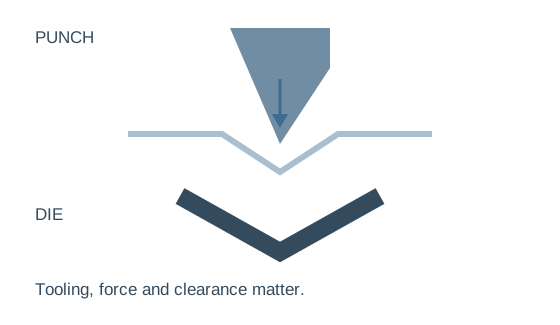
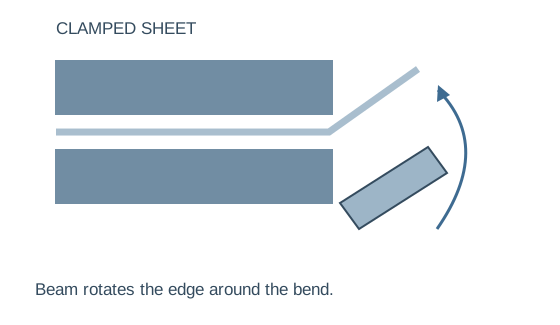
Start with the part that is hardest to make
The broadest panel
Check how the sheet is supported, held and repositioned. A simple bend can still demand considerable handling on a large HVAC panel.
The strongest / thickest part
Confirm grade-specific capacity at the full bending length with the proposed tooling. Maximum length and nominal force are not a universal thickness rating.
The deepest return or box
Check the later bends and part removal. A first bend that works does not prove clearance for the complete sequence.
What moves, what holds, what must clear
| Decision | Press brake | Folding machine |
|---|---|---|
| Tooling | Punch/die geometry and load | Clamping tooling and beam clearance |
| Access | Throat, stroke, open height | Clamping clearance, folding travel, release |
| Handling | Support through the bend sequence | Support during clamp/fold |
| Capacity | Grade, length, tooling, force | Grade, length, tooling, folding limits |
| Acceptance | Complete bent part | Complete folded part and removal |
Scroll the comparison table horizontally to see every column.
Use these differences to organize the trial. They do not assign every panel to a folder or every bracket to a press brake: tooling and the full drawing decide feasibility.
Four checks that belong between the first bend and the quotation
Clamping / positioning
Can the required edge be held and located without interfering with formed features?
The bending sequence
Can later bends clear the tooling, frame and previously bent flanges?
Support and operator handling
Can the intended operators support and turn the representative workpiece at production pace?
Removal of the complete part
Can the finished box or channel be released without changing the required geometry?
Published examples make the capacity discussion concrete
HTC 100T3200 press brake
1000 kN nominal pressure
3200 mm bending length; 320 mm throat; 380 mm open height in the HTC reference table. Review these alongside the force requirement, tool load and part access.
They do not establish a universal material thickness or completed angle tolerance.
WS electric folding range
2500 / 3000 mm example working widths
WS-1.5×2500 lists 0.3–1.5 mm; WS-1.2×3000 lists 0.3–1.2 mm in the folder table. The longer example has a different thickness range.
Confirm grade and angle convention. Ask which clamping/tool arrangement the quoted machine includes.
Compare the same production job on both proposals
Broad panel / flashing scenario
Demonstrate positioning, edge folding and release on the actual blank. Count support labor and repeated handling as part of the cycle, not as an invisible extra.
Bracket / multi-bend scenario
Demonstrate the entire bend sequence, including the short flange and final return. Count tooling changes, repositioning and inspection with the intended operator arrangement.
- Develop a feasible bend/fold sequence for each sample part.
- Check tool access, collision clearance and part removal.
- Confirm material capacity over the full working length.
- Demonstrate support and repositioning at production pace.
- Include tooling changes, inspection and finishing in the cost comparison.
Programming can reduce repeated setup but does not eliminate tooling limits. Read CNC versus conventional hydraulic control before treating CNC as a different force-generating process.
Control options do not remove geometry constraints
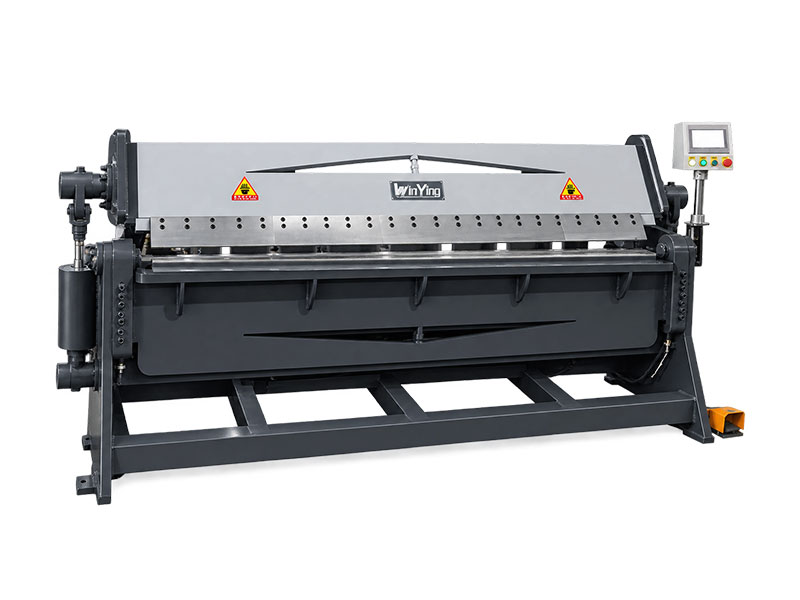
Confirm the exact supplied machine
The current hydraulic folding reference contains mixed manual/hydraulic descriptions. Ask for the actual clamping and folding actuation, tooling, supports and control functions in the quotation.
Likewise, CNC on a press brake describes control functions, not an exemption from force or clearance checks. Review control versus drive when deciding which programming functions are useful.
Send three representative parts
WinYing Machinery reviews the actual workpiece and production needs before discussing bending or folding configurations. Include the difficult return and material, then agree a complete-part trial.
Discuss this application →- 01Widest, thickest and most difficult part drawings
- 02Grade, thickness, radii and flange dimensions
- 03Tolerances and cosmetic requirements
- 04Batch mix, tooling and operator arrangements
Frequently Asked Questions
Can a press brake replace every folder?
Only after checking the complete sequence, tooling, access and handling. Shared straight-bend capability does not establish interchangeability.
Does 1000 kN define thickness capacity?
No. Material, length, tooling and process determine required force.
Can a folder make every box?
Confirm the clamping/finger arrangement, clearance and removal for the actual box drawing.
Which is cheaper to operate?
Compare handling, cycles, changes, labor and rework on the same parts.
What is needed for a quotation?
Material grade, thickness, drawings, bend lengths/radii, tolerances, quantities and surface requirements.