
Electric Folding Machine
Match the WS or TDF electric folder to panel width, prepared-edge geometry and the complete powered-operation scope.
- Source groups
- WS / TDF
- Widths
- 1300–3000 mm
- 3000 mm row
- 0.3–1.2 mm
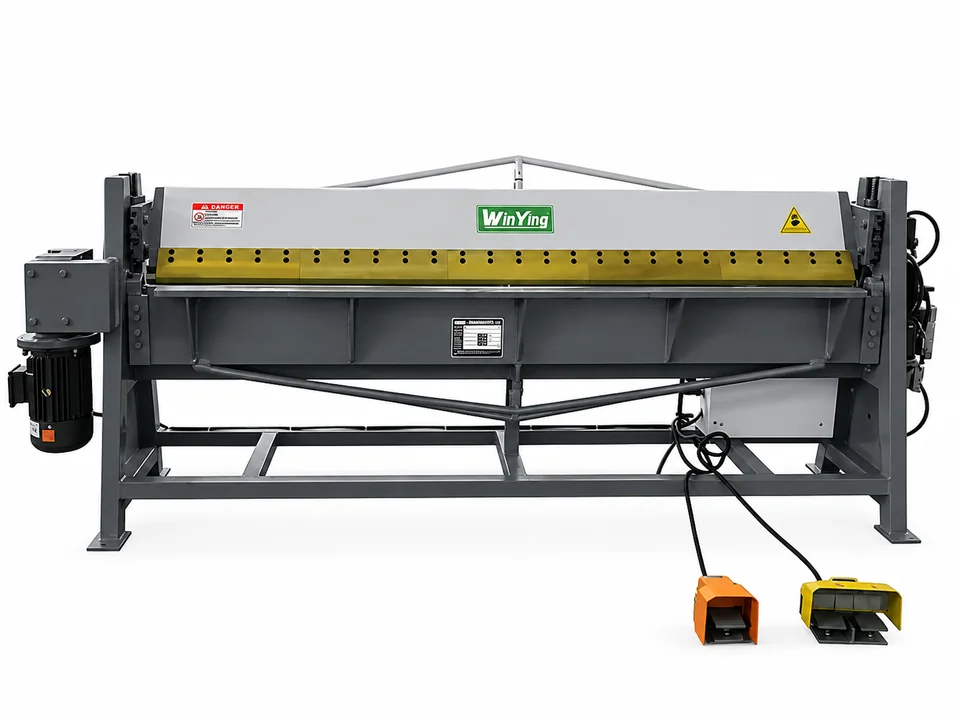
WS and TDF rows need different shortlists
| Group | Listed working widths | Thickness reference |
|---|---|---|
| WS-1.5 | 1300 / 1500 / 2000 / 2500 mm | 0.3–1.5 mm |
| WS-1.2×3000 | 3000 mm | 0.3–1.2 mm |
| TDF-1.5 | 1500 / 2000 / 2500 mm | 0.3–1.5 mm |
For duct panels, check the prepared edges
Existing flanges and longitudinal edges
Provide the panel as it enters the folder, including any seam pockets, beads or TDF edges. Confirm how the tooling supports the part and whether prepared features clear the clamp and folding motion.
For ordinary straight panels, use the longest repeated bend and the complete return section. Review support and repositioning rather than specifying only the maximum flat sheet width.
Define the powered scope in the quotation
Clamping
Confirm which clamping motions are powered and how positioning is performed.
Folding drive
Agree the drive, controls and angle-setting procedure for the selected model.
Site electricity
Motor rating and destination power standard are not supplied in the model table. Obtain these from the selected quotation.
Eight Electric Folding Configurations
| Model | Min. Folding Angle | Plate Thickness | Max. Plate Width | Weight | Dimensions (mm) |
|---|---|---|---|---|---|
| WS-1.5×1300 | 60° | 0.3–1.5 mm | 1300 mm | 360 kg | 1980×800×1320 |
| WS-1.5×1500 | 60° | 0.3–1.5 mm | 1500 mm | 380 kg | 2180×800×1320 |
| WS-1.5×2000 | 60° | 0.3–1.5 mm | 2000 mm | 440 kg | 2680×800×1320 |
| WS-1.5×2500 | 60° | 0.3–1.5 mm | 2500 mm | 560 kg | 3180×800×1320 |
| WS-1.2×3000 | 60° | 0.3–1.2 mm | 3000 mm | 680 kg | 3860×800×1590 |
| TDF-1.5×1500 | 60° | 0.3–1.5 mm | 1500 mm | 450 kg | 2180×800×1320 |
| TDF-1.5×2000 | 60° | 0.3–1.5 mm | 2000 mm | 550 kg | 2680×800×1320 |
| TDF-1.5×2500 | 60° | 0.3–1.5 mm | 2500 mm | 660 kg | 3180×800×1320 |
The supplied 60° minimum-angle entries need the same angle-convention confirmation as the required finished part. Do not treat them as an established full working-angle range.
Demonstrate the repeated part sequence
- 01
Prepare a typical panel
Include already formed edges and actual material.
- 02
Approve the first fold
Check dimensions, angle and surface condition.
- 03
Reposition for later bends
Verify clearance and support at each step.
- 04
Run the repeat batch
Include loading, setup and acceptable completed parts.
Questions to settle before ordering
Does the 3000 mm model list 1.5 mm capacity?
No. WS-1.2×3000 lists 0.3–1.2 mm.
Does TDF in the model name mean it forms flanges?
That is not confirmed. It is a folding-series reference; agree actual tooling and prepared-edge compatibility.
Is the motor power confirmed?
No motor rating is supplied in this table. Obtain selected-model electrical requirements.
Does electric operation include powered clamping?
Confirm each powered motion and its controls in the quotation.
What sample should I provide?
The entering panel with seam, bead and flange features, grade, thickness and the final fold sequence.
Tell Us Your Electric Folding Requirements
Send your material, maximum sheet thickness, required working width and fold angle so we can recommend the suitable electric folding machine.