
How a Spiral Duct Machine Works
Published · Updated
Follow the strip through edge forming, diameter tooling, seam locking and cutting. Then choose a configuration around the diameters and changeovers in your orders.
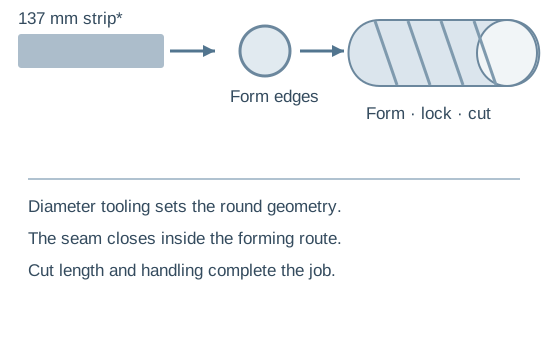
Five operations, one continuous forming route
- 01Load & track
Match coil and strip data; keep the material feeding steadily.
- 02Prepare edges
Roll-form the mating edges used for the mechanical seam.
- 03Set diameter
Select the head or forming arrangement for the quoted diameter.
- 04Form & lock
Guide the strip into tube and interlock adjacent edges.
- 05Cut & discharge
Cut the order length and support the completed duct.
What happens at the forming head
Diameter is a tooling decision
The head guides the strip into its circular path. On the tube-mold reference, changing diameter means changing to the corresponding forming mold. A diameter range in a catalog does not mean every intermediate mold is supplied.
List the actual diameters, including the sizes that appear only occasionally. Request a mold list and a changeover demonstration so rare orders do not reveal missing tooling.
The joint is a mechanical seam
Prepared strip edges meet along a helical path and are mechanically locked. Inspect the complete engagement, not just the appearance of the outside seam. This operation differs from closing a straight longitudinal seam on a rolled tube.
If the construction calls for welding, do not assume the listed former provides it. Define a separate confirmed welding route.
Two published configurations to investigate
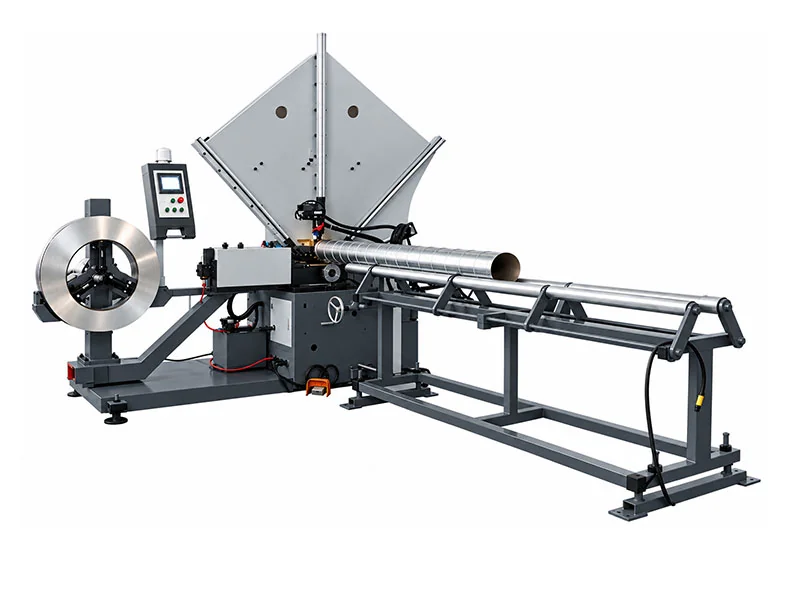
BYL-1500 steel-strip former
80–1500 mm diameter; 137 mm strip; 1–45 m/min listed working speed. Roller cutting is listed, with plasma optional.
View configuration →Interchangeable tube-mold system
100–1600 mm diameter; 137 mm strip; 0–35 m/min feeding speed. Confirm the included forming head molds.
View configuration →| Material check | BYL-1500 | Tube-mold system |
|---|---|---|
| Listed sheet range | 0.4–1.2 mm; confirm material basis | Galvanized 0.5–1.2 mm |
| Stainless reference | 0.4–0.8 mm | 0.4–1.0 mm |
| Cutting route | Roller cutter; plasma optional | Rolling-type cutter |
Scroll the comparison table horizontally to see every column.
Sources are the linked product specifications. These are configuration references, not universal capacities for every grade. Working speed and feed speed are different labels and do not establish completed ducts per hour.
A workshop making one diameter differs from a mixed-size shop
Long runs of straight duct
For repeat orders in one diameter, investigate stable coil tracking, supported cut lengths and efficient discharge. Measure continuous accepted output together with the time needed to remove and store finished tube.
Frequent changes between diameters
For mixed ventilation orders, include mold changes, first-piece adjustment and coil changes. The faster nominal machine may offer less useful output if changeovers and fitting work dominate the shift.
For multiple diameters, list the required mold sizes and ask which are included. Record tooling changes, first-piece adjustment, coil changes and handling in the output estimate. Commercial ventilation runs and industrial duct orders can have very different size mixes.
A former produces straight duct; elbows and fittings require separate fabrication planning. Review segmented elbow production and allocate space for fitting assembly and inspection. Check uncoiler load, lifting access, discharge rack and services in the installation layout.
Acceptance starts with the finished tube
Use your actual sheet at representative diameters. Agree checks for seam engagement, diameter, straightness and cut length. Request a diameter-change demonstration and a continuous run, with usable output counted after inspection. Working speed and feeding speed are not equivalent to finished duct per hour.
Plan your diameter and mold package
WinYing Machinery reviews material, dimensions and production needs before discussing a configuration. Send the diameter list so the quotation covers tooling and downstream fittings as well as the former.
Discuss this application →- 01Grade and sheet thickness
- 02Strip width and coil specification
- 03Duct diameters and cut lengths
- 04Batch mix, utilities and fitting route
Frequently Asked Questions
Does the machine weld the seam?
The configurations discussed here mechanically form and lock the spiral seam. A welded construction needs a separately confirmed process.
Can one tube-mold machine make several diameters?
Yes, by changing corresponding forming head molds within the listed range. Confirm the sizes and quantities supplied.
Is feeding speed finished output?
No. Diameter, cut length, setup, handling and coil changes affect useful output.
What information is needed?
Send material grade, thickness, strip width, coil details, diameters, cut lengths, output needs and destination power supply.